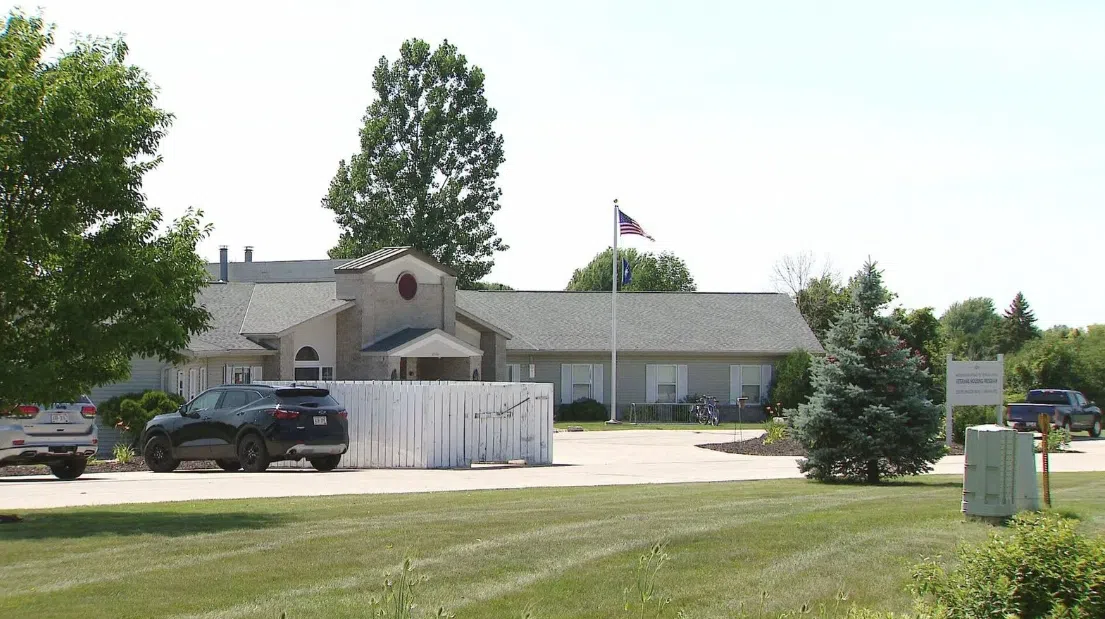
Veteran Housing and Recovery Program facility in Green Bay, July 15, 2025. PC: Fox 11 Online
GREEN BAY, WI (WTAQ-WLUK) — Frank Torres is a military veteran who once used the Veterans Housing and Recovery Program in Green Bay to get back on his feet.
That facility is now set to close by Sept. 30.
“I’m still having problems realizing how this got through the budget,” Torres said. “I don’t know how you look at an item like at-risk veterans or homeless veterans, and just say no.”
It comes after the Republican-controlled Joint Finance Committee did not approve Gov. Tony Evers’ request for $1.9 million in funding for the VHRP in the 2025-27 state budget. As a result, two of the state’s three VHRP facilities — Green Bay and Chippewa Falls — will shut down, leaving only the Union Grove location.
VHRP provides temporary housing for military veterans who are homeless or at risk of becoming homeless, in addition to employment training, education, health care services and substance abuse recovery.
State Senator Eric Wimberger, R-Oconto, is a member of the Joint Finance Committee. He shared a statement explaining why the money wasn’t allocated by the JFC.
The Veterans Housing and Recovery Program has capacity to serve 105 veterans statewide, and is operating at a daily average of about 70% capacity. Governor Evers unilaterally grew funding for this program with COVID relief funds, and now demands Wisconsin’s taxpayers backfill his expiring federal spending. The budget, signed into law by Governor Evers, increases program funding by 15% to cover inflationary and other cost increases. As a veteran and former Marine, I resent the Governor telling half truths about veterans for cheap political headlines.
In a news release, Evers said the Joint Finance Committee approved “$0 in new funding” in the state budget for the VHRP. Meanwhile, Wimberger’s office said, “This is not true — the finance committee authorized an additional $100,000 annually, or a 15% increase.”
State Senator Jamie Wall, D-Green Bay, has proposed a bill that aims to reinstate the $1.9 million in funding for VHRP that was left out of the state budget, in an effort to save the two locations from shutting down.
“These people have done more for our country than just about anyone else, so I think we owe it to them to try to help them — especially if they’re at risk for not having a place to live,” said Wall. “This seemed like a no-brainer to me, and it’s a shame that we didn’t get this sorted out in the budget, so we’re trying to fix it now.”
Torres said it was disappointing to hear the Green Bay facility he once lived at won’t be available to other veterans in the future when they need help.
“When we’ve lost faith in ourselves, they’re the ones who are reaching out their hands and trying to pull us up,” he said. “They pulled me up. It simply breaks my heart just to consider the possibility that other veterans aren’t going to have that choice.”
Joey Hoey with the Wisconsin Department of Veteran Affairs said it will need to relocate 16 veterans currently using the Green Bay facility.
“These veterans, we will be working with them to find them alternate placements in other programs, but it most likely won’t be another veterans centered program,” Hoey said.
The lack of a veteran-specific program likely means veterans will lose access to counseling, education and a comprehensive transition program.
Torres said it’s important to keep resources like the Veterans Housing and Recovery Program available for those who need it. He believes this sets a bad example for those currently serving our country.
“What kind of message are we sending to them when they open up their hometown newspaper, or they look at their local news online, and realize that we are cutting back services that are meant to help veterans? I think we’re sending the wrong message to those who are, right now, serving in dangerous conditions overseas,” Torres said.
In his statement, Senator Wimberger listed a number of programs funded in the state budget related to veterans. Among them, a $2.5 million one-time payment to support Veterans Community Project, which provides housing for homeless veterans, and $150,000 in segregated funds to help counties provide transportation to medical facilities for veterans.


Comments