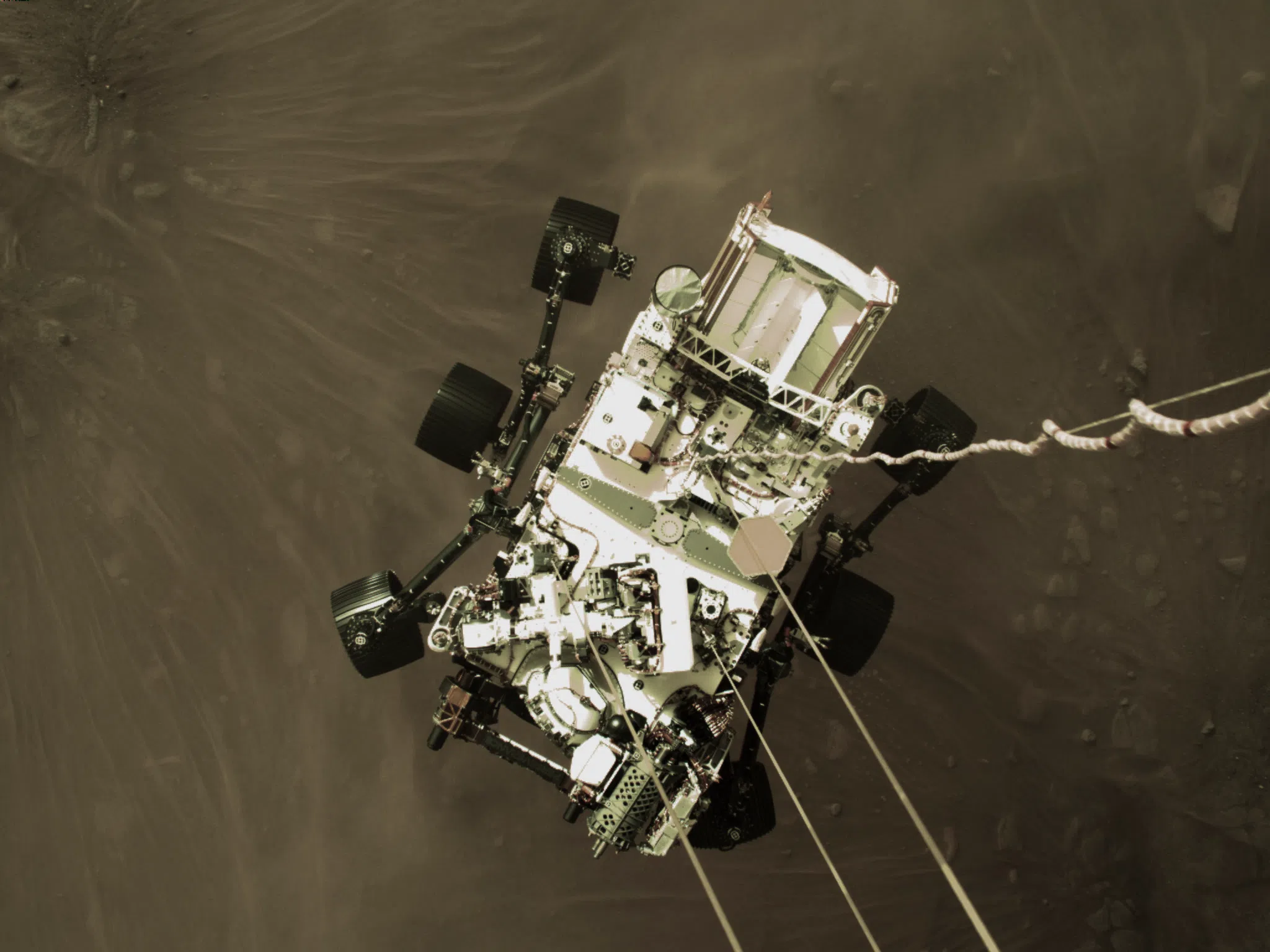
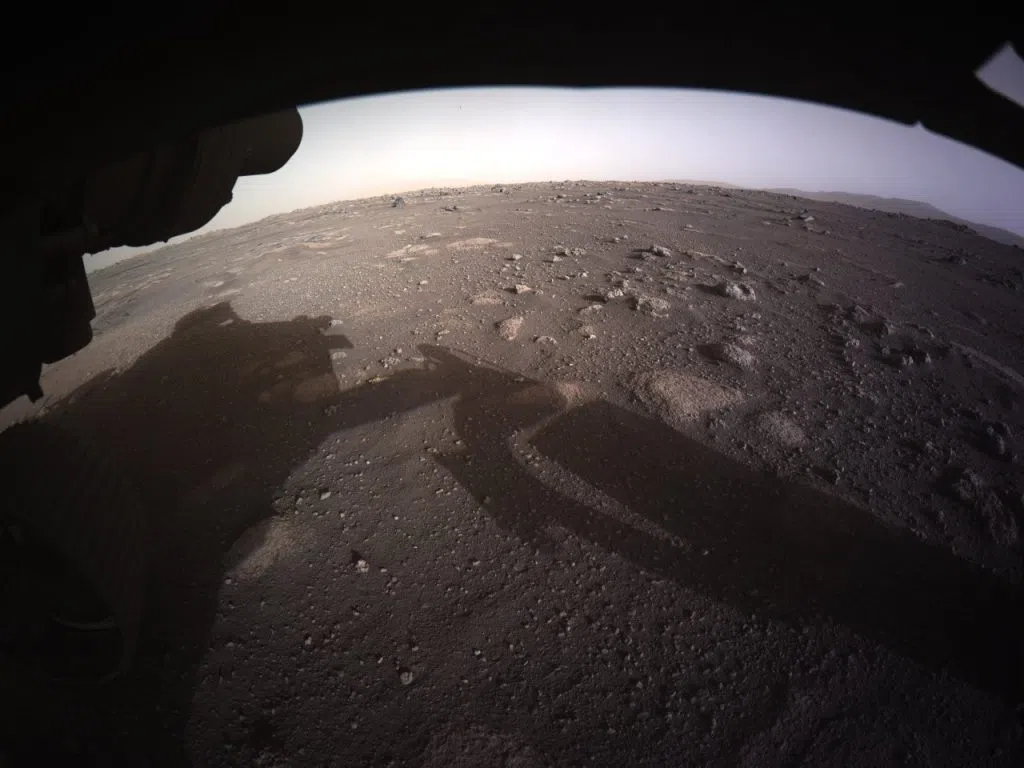
An image captured by the Perseverance Rover of the Martian surface. (NASA/JPL-Caltech)
MENASHA, WI (WTAQ) — The Perseverance Rover is now on Mars after making planetfall Thursday.
It’s an event that Alan Peche, director of the Barlow Planetarium, part of UW-Oshkosh, watched with great interest as the spacecraft arrived on the surface of the red planet after seven months in space.
“NASA made this look very easy. This is not easy,” Peche told WTAQ. “Getting a spacecraft to another planet is hard. Landing a rover on another planet after you get it to the planet is even harder.”
Landing the rover, which is about the size of a Mini Cooper, was an extremely delicate, high-stakes affair that involved launching a sky crane from above the Martian atmosphere that would then float near the surface, lower the lander to the Martian ground, and then fly away and crash where it wouldn’t be likely to harm to rover. At mission control, it was a blood-pressure-raising affair, as the entire process is automated. Had something went wrong, the $28 billion project would almost certainly have been totally lost.
There is an 11-minute delay between signals from the rover and earth, so by the time the team learned that the sky crane had launched, Perseverance was already on the ground.
The rover is on Mars to take core samples of the red planet that could eventually be taken on another rocket back to Earth on a possible future mission.
It’s also there to look for ancient signs of life that scientists speculate may have once existed on Mars.
“I think it would be very interesting to know that life isn’t as rare in space [as we thought],” said Peche.
The Perseverance landed on a region of Mars believed to be an ancient dry lake bed, where scientists believe evidence of ancient microbial life. There is speculation Mars may have been hospitable to life during the era of solar history in which our sun was brighter, temporarily making Mars a more viable planet for life than Earth.


